

We build developer tooling where the gate is enforced, not suggested.
Intent goes in. A gate-verified PR comes out. Every time.
One rule runs through everything here: no code reaches a branch without clearing the same gated pipeline, and the proof is never forgeable. We build that rule at two depths.
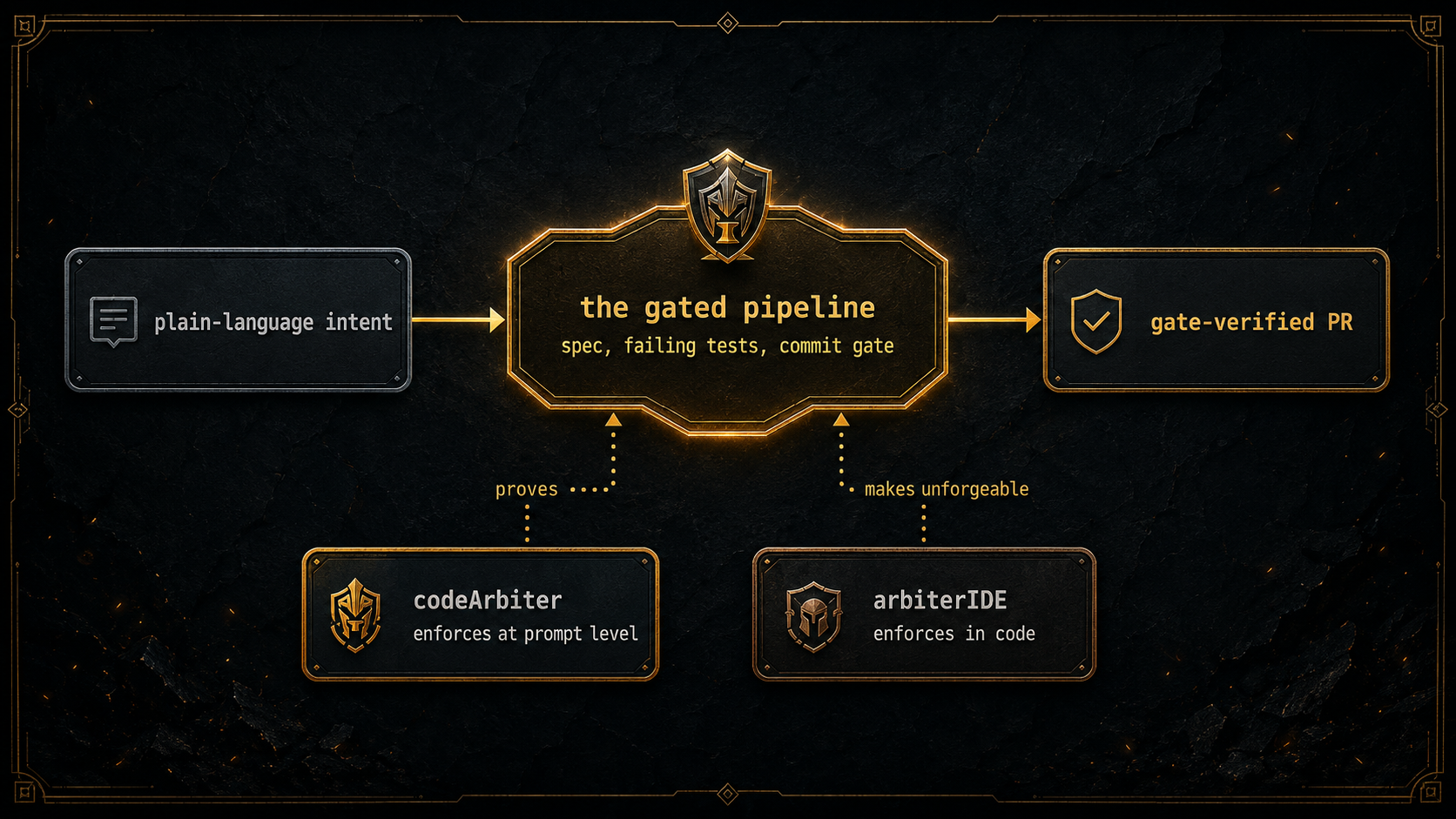




A governance layer for Claude Code and OpenAI Codex that refuses
to freelance. Every intent routes through a host-native command to a gated skill or reviewer agent.
Nothing commits until the gates are green, architectural forks are scored through SMARTS instead of
guessed at, and the audit trail (overrides.log, ADRs, the sprint log) is append-only and
mechanically guarded. It proves the workflow at prompt level, inside the session, for both hosts
from one shared policy core.
/plugin marketplace add arbiterForge/codeArbiter
/plugin install ca@codearbiter
Requires Python 3 on PATH. Dormant in every repo until you run /ca:init, and it writes only to
.codearbiter/. See arbiterForge/codeArbiter.


Proving the workflow at prompt level has a ceiling. A gate that lives in a transcript is skippable by a sufficiently creative session, and evidence written as a marker file can be forged. arbiterIDE moves the structure into code. Gates become interceptors at a single tool-dispatch chokepoint. Evidence becomes unforgeable HMAC tokens bound to content hashes. The commit path becomes the only commit path, and CI independently re-derives the verdict server-side, so even a hostile client cannot fake one.
Built on Eclipse Theia, shipped desktop-first as a branded Electron app. Early and pre-alpha by
design: the full build plan lives in a governed .codearbiter/ state store the IDE reads and
writes itself, and the repo names what's still scaffolded rather than implying it's all wired.
Private for now. See arbiterForge/arbiterIDE.
The two projects are licensed differently — check before you build on either. codeArbiter is AGPLv3; network use of a modified version obligates you to offer that version's source. arbiterIDE is PolyForm Noncommercial 1.0.0: free for personal and noncommercial use, with commercial rights reserved. Both hold open a path to a separate commercial license — ask in an issue on the relevant repo.
Open an issue on codeArbiter or arbiterIDE, or start a conversation in Discussions.