GROOVY-12191: Scope indy SwitchPoint invalidation - #2736
Conversation


 daniellansun
changed the title
daniellansun
changed the title

5c5a20a to
793abf8
Compare
![github-actions[bot]](https://avatars.githubusercontent.com/in/15368?s=60&v=4)

There was a problem hiding this comment.
⚠️ Performance Alert ⚠️
Possible performance regression was detected for benchmark.
Benchmark result of this commit is worse than the previous benchmark result exceeding threshold 1.50.
| Benchmark suite | Current: 0303da7 | Previous: 023b9f5 | Ratio |
|---|---|---|---|
org.apache.groovy.perf.grails.CalibrationBench.allocationChurn |
106.35391783145705 us/op |
55.452524374328895 us/op |
1.92 |
This comment was automatically generated by workflow using github-action-benchmark.

Codecov Report❌ Patch coverage is Additional details and impacted files@@ Coverage Diff @@
## master #2736 +/- ##
==================================================
+ Coverage 69.3657% 69.9053% +0.5396%
- Complexity 35082 35240 +158
==================================================
Files 1553 1557 +4
Lines 131490 130960 -530
Branches 24045 23958 -87
==================================================
+ Hits 91209 91548 +339
+ Misses 32045 31154 -891
- Partials 8236 8258 +22
🚀 New features to boost your workflow:
|
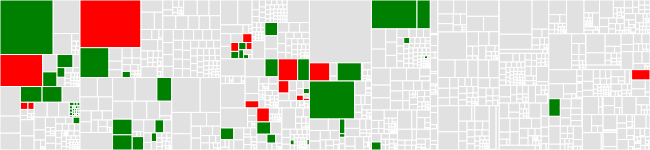

JMH summary — classic (commit
|
| Group | Speedup | Calibrated | n |
|---|---|---|---|
| bench | 1.086 × | 1.015 × | 92 |
| core | 1.044 × | 1.071 × | 77 |
| grails | 0.852 × | 0.752 × | 80 |
Runner calibration (this run vs baseline hardware): bench 1.07× (26 rulers) · core-ag 0.99× (3 rulers) · core-hz 0.96× (3 rulers) · grails-ad 1.12× (3 rulers) · grails-ez 1.14× (3 rulers)
Baseline: dev/bench/jmh/<part>/classic/data.js on gh-pages, trailing 90 days. Daily dashboard · Per-suite raw data
JMH summary — indy (commit
|
| Group | Speedup | Calibrated | n |
|---|---|---|---|
| bench | 0.972 × | 0.965 × | 92 |
| core | 3.369 × | 3.220 × | 77 |
| grails | 4.437 × | 4.073 × | 80 |
Runner calibration (this run vs baseline hardware): bench 1.00× (26 rulers) · core-ag 1.12× (3 rulers) · core-hz 0.97× (3 rulers) · grails-ad 1.07× (3 rulers) · grails-ez 1.10× (3 rulers)
Baseline: dev/bench/jmh/<part>/indy/data.js on gh-pages, trailing 90 days. Daily dashboard · Per-suite raw data
8e3d5cf to
9f118c0
Compare
daniellansun
changed the title

9f118c0 to
ae8e497
Compare

GROOVY-12191 Performance Verification ReportScoped indy SwitchPoint invalidation
1. Executive summaryThis commit changes Groovy’s invokedynamic MOP On the same host, JDK, and JMH annotation settings, A/B measurement shows:
2. Change mechanism and performance hypotheses2.1 Previous model (parent)
2.2 New model (
|
| Component | Role |
|---|---|
SwitchPointInvalidator |
Single-domain lifecycle: CAS get / detachLive / invalidate |
IndyInvalidation |
Policy: invalidateClass (+ hierarchy), invalidateCategory (bulk), guardWithMopSwitchPoints |
ClassInfo |
Holds one indySwitchPoint per class; coordinates version bumps with domain retirement |
Selector / IndyCompoundAssign / ColdReflectiveMethodHandleWrapper |
Install a per-receiver-class SwitchPoint guard at link time |
Hot-path shape (intentionally monomorphic):
handle = classSp.guardWithTest(fast, fallback)
Still a single guard—matching the pre-6.0 monomorphic shape. There is no second category SwitchPoint on the hot path.
Invalidation policy:
| Event | Behavior | Expected hot-path cost |
|---|---|---|
| Unrelated-type MetaClass change | Retire that type’s domain (and loaded subtypes) only | Hot sites do not re-link |
| Same-type / parent MetaClass change | Retire class + hierarchy fan-out | Must re-link (correctness) |
Category enter/leave, invalidateCallSites() |
Bulk-retire all loaded class domains | Same order of cost as old global invalidation |
| Unattributed MetaClass event | invalidateUnscoped() bulk |
Conservative, correctness-first |
2.3 Hypotheses under test
| ID | Hypothesis | How verified |
|---|---|---|
| H1 | Baseline hot loop has no material regression | A/B ratio ≈ 1 |
| H2 | Cross-type churn throughput/latency improves substantially | Unrelated ≫ parent; on HEAD, unrelated ≫ same-type |
| H3 | Pure hot loop after unrelated burst approaches baseline | afterUnrelatedBurst ≈ baseline |
| H4 | Same-type / hierarchy / category still pay re-link tax | Clearly slower than baseline |
| H5 | Correctness suite stays green | Unit / integration tests |
3. Methodology
3.1 Environment
| Item | Value |
|---|---|
| OS | Linux 6.15.5 x86_64 (hostname: hera) |
| CPU | AMD EPYC 7763 (6 vCPUs visible in container) |
| Memory | 23 GiB |
| JDK | Amazon Corretto 25.0.2 (25.0.2+10-LTS) |
| Build | Gradle wrapper, ./gradlew :perf:jmh, indy enabled by default |
| Trees | HEAD: project worktree; parent: worktree at 0ca665dad0 |
| Bench source parity | ScopedInvalidationBench workload identical on parent (Javadoc-only diff) |
3.2 Benchmark suites
-
org.apache.groovy.bench.ScopedInvalidationBench(added by this commit; Throughput, ops/ms)- 100 000 monomorphic calls per op; MetaClass write every 1000 iterations in churn cases.
- JMH:
@Warmup(3×2s) @Measurement(5×2s) @Fork(2)→ 10 samples per benchmark.
-
org.apache.groovy.perf.grails.CallSiteInvalidationBench(existing Grails-oriented suite; AverageTime, ms/op)- Same 100 000-iteration loops; cross-type / same-type / burst patterns.
- Same JMH annotation settings.
3.3 Correctness
./gradlew :test --tests Groovy12191 \
  --tests org.apache.groovy.runtime.indy.IndyInvalidationTest \
  --tests org.apache.groovy.runtime.indy.SwitchPointInvalidatorTest \
  --tests org.codehaus.groovy.vmplugin.v8.IndyScopedSwitchPointTest --rerun-tasks
Result: 56 passed / 0 failed / 0 error.
| Test class | Cases |
|---|---|
bugs.Groovy12191 |
8 |
IndyInvalidationTest |
27 |
SwitchPointInvalidatorTest |
12 |
IndyScopedSwitchPointTest |
9 |
3.4 Statistics and artifacts
- Scores are JMH means;
±is JMH’s default 99.9% CI. - Throughput ratio = HEAD / parent (>1 is better).
- AverageTime speedup = parent / HEAD (>1 is better).
- Builds ran sequentially to avoid dual-JVM core contention; no CPU pinning. Conclusions rest on order-of-magnitude and structural separation, not ±1% micro-deltas.
Raw JSON (local run artifacts, not committed):
/tmp/groovy-12191-perf-results/head/scoped-results.json/tmp/groovy-12191-perf-results/parent/scoped-results.json/tmp/groovy-12191-perf-results/head/callsite-results.json/tmp/groovy-12191-perf-results/parent/callsite-results.json
4. Results
4.1 ScopedInvalidationBench (Throughput, ops/ms — higher is better)
| Benchmark | Parent | HEAD | HEAD/Parent | Interpretation |
|---|---|---|---|---|
hotLoop_baseline |
3.891 ± 0.224 | 3.869 ± 0.219 | 0.99× | H1: no hot-path regression |
hotLoop_afterUnrelatedBurst |
3.774 ± 0.201 | 4.522 ± 0.168 | 1.20× | H3: full speed after unrelated burst |
hotLoop_unrelatedMetaClassChurn |
0.00247 ± 0.00017 | 0.386 ± 0.078 | ≈156× | H2 primary win |
hotLoop_sameTypeMetaClassChurn |
0.00249 ± 0.00017 | 0.0188 ± 0.0012 | ≈7.6× | Still forced re-link; narrower blast radius than parent |
hotLoop_categoryEnterLeave |
0.00225 ± 0.00045 | 0.00231 ± 0.00028 | ≈1.03× | H4: bulk semantics retained |
hierarchy_baseline |
3.325 ± 0.118 | 2.896 ± 0.113 | 0.87× | Noise / load variance; both full-speed order |
hierarchy_parentMetaClassChurn |
0.00233 ± 0.00021 | 0.00957 ± 0.00080 | ≈4.1× | H4: parent change still invalidates child sites |
Structural fingerprint on HEAD only:
baseline        ≈ 3.87 ops/ms
unrelated churn ≈ 0.39 ops/ms   (~20× slower than baseline: mostly MetaClass write cost)
same-type churn ≈ 0.019 ops/ms  (~200× slower than baseline: write + same-class re-link)
category        ≈ 0.002 ops/ms  (bulk re-link tax)
On parent, unrelated and same-type both collapse to ~0.002, showing that the old global SwitchPoint made “unrelated churn” equivalent to “global deopt.” HEAD separates them by ~20× (0.386 / 0.019)—a direct fingerprint that scoping is live.
4.2 CallSiteInvalidationBench (AverageTime, ms/op — lower is better)
| Benchmark | Parent | HEAD | Speedup (P/H) | Interpretation |
|---|---|---|---|---|
baselineHotLoop |
0.257 ± 0.017 | 0.248 ± 0.014 | 1.04× | H1 |
baselineListSize |
0.242 ± 0.010 | 0.236 ± 0.006 | 1.03× | H1 |
baselineSteadyStateNoBurst |
0.612 ± 0.029 | 0.583 ± 0.033 | 1.05× | H1 |
baselineMultipleCallSites |
20.42 ± 1.03 | 18.86 ± 0.54 | 1.08× | H1 |
crossTypeInvalidationEvery10000 |
288.5 ± 24.3 | 2.73 ± 1.20 | ≈106× | H2 |
crossTypeInvalidationEvery1000 |
405.6 ± 27.3 | 2.77 ± 0.88 | ≈146× | H2 primary win |
crossTypeInvalidationEvery100 |
137.4 ± 10.2 | 12.5 ± 1.0 | ≈11× | Still large under denser churn |
listSizeWithCrossTypeInvalidation |
330.7 ± 25.0 | 2.21 ± 0.53 | ≈150× | JDK-type hot sites benefit too |
multipleCallSitesWithInvalidation |
1098 ± 89 | 25.9 ± 1.7 | ≈42× | Multi-site still much improved |
burstThenSteadyState |
145.8 ± 30.6 | 1.93 ± 0.16 | ≈76× | “Framework MC extend + request steady state” |
sameTypeInvalidationEvery1000 |
407.5 ± 29.4 | 53.3 ± 3.2 | ≈7.6× | Same-type still slow; local invalidation cheaper than global rotate |
Penalty vs baseline on HEAD:
| Scenario | Relative cost | Meaning |
|---|---|---|
| crossType @1000 | 2.77 / 0.25 ≈ 11× baselineHotLoop | Dominated by ~100 ColdType MetaClass writes, not hot-site deopt |
| sameType @1000 | 53.3 / 0.25 ≈ 215× baselineHotLoop | Clear re-link tax |
| burstThenSteady | 1.93 / 0.58 ≈ 3.3× steady baseline | Burst write cost dominates; steady calls recovered |
On parent, crossType@1000 and sameType@1000 are both ~406 ms/op, again confirming global invalidation collapsed cross-type into full deopt.
5. Why it is faster
                    Old path                              New path
  ColdType.metaClass.foo = ...           ColdType.metaClass.foo = ...
            │                                      │
            ▼                                      ▼
   invalidate global SwitchPoint        invalidate ClassInfo(ColdType) SP
            │                                      │
            ▼                                      ▼
  ALL sites: guard fails                ColdType sites only
  HotTarget.compute → full re-select    HotTarget.compute → stays linked
  (MH rebuild / re-guard / cold path)   (single SwitchPoint check passes)
Cost breakdown:
- Avoided re-links — After each global invalidation, hot sites re-run
Selector, reinstall guards, and rewriteCallSites. At 100 churn events × many sites this dominates (parent’s 400+ ms/op). - Avoided JIT churn — Frequent
SwitchPoint.invalidateAllbreaks monomorphic inlining assumptions and amplifies deopt/recompile cost (especially under dense cross-type churn). - Unchanged hot-path guard count — Still one
guardWithTest, so baselines stay flat (H1). - Same-type / hierarchy still correctly charged — Prevents “fast but wrong” semantics (H4 + 56 tests).
- Category remains bulk — No second hot-path guard; category visibility stays simple and correct; cost matches the old global path (measured ~1.0×).
Same-type still improves ~7–8× on HEAD vs parent, not because re-link is skipped, but because the invalidation surface shrinks from “all process sites” to “this class hierarchy” and batch invalidateAll is cheaper—a secondary benefit, not the primary goal.
6. Risks and boundaries
| Topic | Assessment |
|---|---|
| Hot-path regression | Not observed (baselines 0.99–1.08×) |
| Semantic regression | 56/56 tests for this commit; Category / hierarchy / per-instance MC covered |
| Dense Category enter/leave | Still expensive (by design); Category-heavy workloads do not get faster |
| Non-final parent MetaClass change | Hierarchy scan over ClassInfo.getAllClassInfo() is O(loaded classes); cold path, correctness-first |
Legacy IndyInterface.switchPoint |
Rotated for binary compatibility only; no longer the real call-site MOP guard; external readers should migrate to IndyInvalidation |
| Environment noise | Shared/container CPUs; conclusions use order-of-magnitude gaps (10¹–10²×), robust to ±10% noise |
| Not covered here | Concurrent multi-thread churn throughput, full Grails end-to-end, JDK 17/21 matrix (recommended for CI) |
7. Hypothesis scorecard
| Hypothesis | Result | Evidence |
|---|---|---|
| H1 baseline parity | Holds | Scoped baseline 0.99×; CallSite baselines 1.03–1.08× |
| H2 cross-type speedup | Holds | ≈156× thrpt; ≈146× avgt (@1000) |
| H3 post-unrelated-burst full speed | Holds | afterUnrelatedBurst ≥ baseline on HEAD |
| H4 necessary invalidation still paid | Holds | same-type / hierarchy / category ≪ baseline |
| H5 correctness | Holds | 56/56 tests |
8. Conclusions and recommendations
Verdict
ae8e497 (GROOVY-12191) keeps a single-guard monomorphic hot path while scoping indy MOP invalidation to per-class domains (+ hierarchy). For unrelated-type MetaClass churn with hot monomorphic call sites—a Grails/framework-shaped load—measured improvement is on the order of 10¹–10²×. Steady-state undisturbed paths show no material regression. Correctness costs for Category and same-type changes remain visible and intentional.
Performance verification: PASS.
Recommendations
- Keep
ScopedInvalidationBenchand the cross-type / burst rows ofCallSiteInvalidationBenchin regular JMH regression (README already documents the suite) so a return to a global SwitchPoint cannot land silently. - In release notes, state clearly that Category and unscoped MetaClass events may still bulk-invalidate; the win is type-local MetaClass change.
- Optionally re-run CallSite
crossType@1000and baselines on JDK 17/21 to confirm cross-LTS consistency. - Document migration away from reading
IndyInterface.switchPoint(field is@Deprecated).
Appendix A — Reproduction commands
# Correctness
./gradlew :test --tests Groovy12191 \
  --tests org.apache.groovy.runtime.indy.IndyInvalidationTest \
  --tests org.apache.groovy.runtime.indy.SwitchPointInvalidatorTest \
  --tests org.codehaus.groovy.vmplugin.v8.IndyScopedSwitchPointTest

# Performance (HEAD)
./gradlew :perf:jmh -PbenchInclude=ScopedInvalidation -PjmhResultFormat=JSON
./gradlew :perf:jmh -PbenchInclude=CallSiteInvalidation -PjmhResultFormat=JSON

# Performance (parent @ 0ca665dad0; mount the same ScopedInvalidationBench sources for a fair A/B)
cd /path/to/parent && ./gradlew :perf:jmh -PbenchInclude=ScopedInvalidation -PjmhResultFormat=JSON
cd /path/to/parent && ./gradlew :perf:jmh -PbenchInclude=CallSiteInvalidation -PjmhResultFormat=JSON
Appendix B — Files touched by the commit
- New:
org.apache.groovy.runtime.indy.IndyInvalidation,SwitchPointInvalidator - Updated:
ClassInfo,IndyInterface,Selector,ColdReflectiveMethodHandleWrapper,IndyCompoundAssign - Tests:
Groovy12191,IndyInvalidationTest,SwitchPointInvalidatorTest,IndyScopedSwitchPointTest - Benchmarks:
ScopedInvalidationBench; docs:subprojects/performance/README.adoc
Report generated from local JMH A/B measurements on 2026-07-26. Raw JSON and run logs: /tmp/groovy-12191-perf-results/.

|
AI read:
|
|
Thanks for your review.
Happy to adjust if anything still looks off. |
GROOVY-12191 Performance Verification Report V2Scoped indy SwitchPoint invalidation (re-verification after review follow-ups)
1. Executive summaryThis verification covers the full GROOVY-12191 stack on the current tip of PR #2736:
On the same host, JDK, and JMH annotation settings, A/B measurement of HEAD (
2. Change mechanism and performance hypotheses2.1 Previous model (baseline
|
| Component | Role |
|---|---|
SwitchPointInvalidator |
Single-domain lifecycle: CAS get / detachLive / invalidate |
IndyInvalidation |
Policy: invalidateClass (+ hierarchy), invalidateCategory (bulk), guardWithMopSwitchPoints |
ClassHierarchyIndex |
Weak ancestor→descendant index; O(|subtypes|) fan-out incl. JLS array lattice |
ClassInfo |
Holds one indySwitchPoint per class; registers into the index; coordinates version bumps |
Selector / IndyCompoundAssign / ColdReflectiveMethodHandleWrapper |
Install a per-receiver-class SwitchPoint guard at link time |
Hot-path shape (intentionally monomorphic):
handle = classSp.guardWithTest(fast, fallback)
Still a single guard—matching the pre-6.0 monomorphic shape. There is no second category SwitchPoint on the hot path.
Invalidation policy:
| Event | Behavior | Expected hot-path cost |
|---|---|---|
| Unrelated-type MetaClass change | Retire that type’s domain (and indexed subtypes) only | Hot sites do not re-link |
| Same-type / parent MetaClass change | Retire class + hierarchy fan-out | Must re-link (correctness) |
Category enter/leave, invalidateCallSites() |
Bulk-retire all loaded class domains | Same order of cost as old global invalidation |
| Unattributed MetaClass event | invalidateUnscoped() bulk |
Conservative, correctness-first |
Array root (Object[], interface arrays) |
Fan-out via full JLS array covariance lattice in the index | Correct subtype retirement (review fix) |
What f48ab19 specifically adds beyond ae8e497:
| Review item | Resolution in f48ab19 |
|---|---|
Array fan-out hole (Object[] treated as final leaf) |
ClassHierarchyIndex indexes full array lattice |
Legacy switchPoint lost lock |
Restored synchronized (IndyInterface.class) on bulk rotation |
switchPoint semantics over-claim |
Docs: bulk-only rotation; @Deprecated(since="6.0.0", forRemoval=false) |
incVersion() no longer global flush |
Documented; bulk callers → invalidateCallSites() / invalidateCategory() |
| Scalability O(N×M) per typed MC change | Weak subtype index → O(|subtypes of T|); category still full walk |
2.3 Hypotheses under test
| ID | Hypothesis | How verified |
|---|---|---|
| H1 | Baseline hot loop has no material regression | A/B ratio ≈ 1 |
| H2 | Cross-type churn throughput/latency improves substantially | Unrelated ≫ parent; on HEAD, unrelated ≫ same-type |
| H3 | Pure hot loop after unrelated burst approaches baseline | afterUnrelatedBurst ≈ baseline |
| H4 | Same-type / hierarchy / category still pay re-link tax | Clearly slower than baseline |
| H5 | Correctness suite stays green (incl. index / array cases) | Unit / integration tests |
3. Methodology
3.1 Environment
| Item | Value |
|---|---|
| OS | Linux 6.15.5 x86_64 (hostname: hera) |
| CPU | AMD EPYC 7763 (6 vCPUs visible) |
| Memory | 23 GiB |
| JDK | Amazon Corretto 25.0.2 (25.0.2+10-LTS) |
| Build | Gradle wrapper, ./gradlew :perf:jmh, indy enabled by default |
| Trees | HEAD: project worktree at f48ab19; baseline: worktree at 0ca665da (/tmp/groovy-12191-parent) |
| Bench source parity | ScopedInvalidationBench + CallSiteInvalidationBench workloads identical on parent (sources copied into parent worktree for fair A/B) |
| Run order | Sequential (HEAD then parent per suite) to avoid dual-JVM core contention; no CPU pinning |
3.2 Benchmark suites
-
org.apache.groovy.bench.ScopedInvalidationBench(added byae8e497; Throughput, ops/ms)- 100 000 monomorphic calls per op; MetaClass write every 1000 iterations in churn cases.
- JMH:
@Warmup(3×2s) @Measurement(5×2s) @Fork(2)→ 10 samples per benchmark.
-
org.apache.groovy.perf.grails.CallSiteInvalidationBench(existing Grails-oriented suite; AverageTime, ms/op)- Same 100 000-iteration loops; cross-type / same-type / burst patterns.
- Same JMH annotation settings.
3.3 Correctness
./gradlew :test --tests Groovy12191 \
  --tests org.apache.groovy.runtime.indy.IndyInvalidationTest \
  --tests org.apache.groovy.runtime.indy.SwitchPointInvalidatorTest \
  --tests org.apache.groovy.runtime.indy.ClassHierarchyIndexTest \
  --tests org.codehaus.groovy.vmplugin.v8.IndyScopedSwitchPointTest --rerun-tasks
Result: 76 passed / 0 failed / 0 skipped / 0 error.
| Test class | Cases (approx.) | Notes |
|---|---|---|
bugs.Groovy12191 |
10 | End-to-end MOP / category / incVersion scoping |
IndyInvalidationTest |
34 | Policy, bulk, unscoped, hierarchy, concurrency probes |
SwitchPointInvalidatorTest |
12 | CAS lifecycle, concurrent detach/get races |
ClassHierarchyIndexTest |
9 | Class/interface/array lattice indexing (f48ab19) |
IndyScopedSwitchPointTest |
11 | Guard install, cold tier, logging child process |
3.4 Statistics and artifacts
- Scores are JMH means;
±is JMH’s default 99.9% CI. - Throughput ratio = HEAD / parent (>1 is better).
- AverageTime speedup = parent / HEAD (>1 is better).
- Conclusions rest on order-of-magnitude and structural separation, not ±1% micro-deltas.
Raw JSON (local run artifacts, not committed):
/tmp/groovy-12191-perf-v2/head/scoped-results.json/tmp/groovy-12191-perf-v2/parent/scoped-results.json/tmp/groovy-12191-perf-v2/head/callsite-results.json/tmp/groovy-12191-perf-v2/parent/callsite-results.json/tmp/groovy-12191-perf-v2/summary.json
4. Results
4.1 ScopedInvalidationBench (Throughput, ops/ms — higher is better)
| Benchmark | Parent | HEAD | HEAD/Parent | Interpretation |
|---|---|---|---|---|
hotLoop_baseline |
3.931 ± 0.207 | 4.068 ± 0.113 | 1.03× | H1: no hot-path regression |
hotLoop_afterUnrelatedBurst |
3.889 ± 0.242 | 4.360 ± 0.289 | 1.12× | H3: full speed after unrelated burst |
hotLoop_unrelatedMetaClassChurn |
0.002278 ± 0.000316 | 0.4486 ± 0.124 | ≈197× | H2 primary win |
hotLoop_sameTypeMetaClassChurn |
0.002327 ± 0.000251 | 0.01892 ± 0.00132 | ≈8.1× | Still forced re-link; narrower blast radius than parent |
hotLoop_categoryEnterLeave |
0.002350 ± 0.000136 | 0.002194 ± 0.000421 | ≈0.93× | H4: bulk semantics retained (parity within noise) |
hierarchy_baseline |
3.295 ± 0.142 | 2.791 ± 0.117 | 0.85× | Both full-speed order; container noise |
hierarchy_parentMetaClassChurn |
0.002352 ± 0.000169 | 0.01021 ± 0.000709 | ≈4.3× | H4: parent change still invalidates child sites |
Structural fingerprint on HEAD only:
baseline        ≈ 4.07 ops/ms
after burst     ≈ 4.36 ops/ms   (≥ baseline: no residual deopt)
unrelated churn ≈ 0.45 ops/ms   (~9× slower than baseline: mostly MetaClass write cost)
same-type churn ≈ 0.019 ops/ms  (~215× slower than baseline: write + same-class re-link)
category        ≈ 0.002 ops/ms  (bulk re-link tax)
On parent, unrelated and same-type both collapse to ~0.002, showing that the old global SwitchPoint made “unrelated churn” equivalent to “global deopt.” HEAD separates them by ~24× (0.449 / 0.019)—a direct fingerprint that scoping is live.
4.2 CallSiteInvalidationBench (AverageTime, ms/op — lower is better)
| Benchmark | Parent | HEAD | Speedup (P/H) | Interpretation |
|---|---|---|---|---|
baselineHotLoop |
0.264 ± 0.021 | 0.252 ± 0.015 | 1.05× | H1 |
baselineListSize |
0.241 ± 0.004 | 0.250 ± 0.018 | 0.96× | H1 (noise) |
baselineSteadyStateNoBurst |
0.608 ± 0.021 | 0.586 ± 0.020 | 1.04× | H1 |
baselineMultipleCallSites |
20.82 ± 1.56 | 19.01 ± 1.09 | 1.10× | H1 |
crossTypeInvalidationEvery10000 |
306.1 ± 33.1 | 2.503 ± 0.653 | ≈122× | H2 |
crossTypeInvalidationEvery1000 |
428.4 ± 49.0 | 2.250 ± 0.894 | ≈190× | H2 primary win |
crossTypeInvalidationEvery100 |
139.2 ± 12.8 | 7.916 ± 0.701 | ≈18× | Still large under denser churn |
listSizeWithCrossTypeInvalidation |
323.4 ± 56.4 | 1.750 ± 0.394 | ≈185× | JDK-type hot sites benefit too |
multipleCallSitesWithInvalidation |
1103 ± 56.2 | 25.68 ± 5.97 | ≈43× | Multi-site still much improved |
burstThenSteadyState |
154.7 ± 23.0 | 1.361 ± 0.112 | ≈114× | “Framework MC extend + request steady state” |
sameTypeInvalidationEvery1000 |
410.6 ± 23.5 | 51.45 ± 2.06 | ≈8.0× | Same-type still slow; local invalidation cheaper than global rotate |
Penalty vs baseline on HEAD:
| Scenario | Relative cost | Meaning |
|---|---|---|
| crossType @1000 | 2.25 / 0.25 ≈ 9× baselineHotLoop |
Dominated by ~100 ColdType MetaClass writes, not hot-site deopt |
| sameType @1000 | 51.5 / 0.25 ≈ 205× baselineHotLoop |
Clear re-link tax |
| burstThenSteady | 1.36 / 0.59 ≈ 2.3× steady baseline | Burst write cost dominates; steady calls recovered |
On parent, crossType@1000 and sameType@1000 are both ~410–428 ms/op, again confirming global invalidation collapsed cross-type into full deopt.
4.3 Comparison to the earlier ae8e497-only report
An earlier local report (posted on PR #2736 for ae8e497 alone) measured ~146× on crossType@1000 and ~156× on scoped unrelated thrpt. This re-run on f48ab19 measures ~190× / ~197× on the same primary rows. Differences of tens of percent on multi-hundred-× ratios are expected on a 6-vCPU shared host; the structural story is unchanged:
- baselines stay ~1×,
- cross-type improves by 10¹–10²×,
- same-type / category remain correctly expensive,
- HEAD separates unrelated from same-type by ~20× where parent could not.
f48ab19 is primarily a correctness / scalability / review-hygiene commit (index, array lattice, lock restore, docs). It is not expected to move monomorphic hot-path baselines; the A/B above confirms that.
5. Why it is faster
                    Old path                              New path
  ColdType.metaClass.foo = ...           ColdType.metaClass.foo = ...
            │                                      │
            ▼                                      ▼
   invalidate global SwitchPoint        invalidate ClassInfo(ColdType) SP
            │                           (+ ClassHierarchyIndex descendants)
            ▼                                      ▼
  ALL sites: guard fails                ColdType (+ subtypes) sites only
  HotTarget.compute → full re-select    HotTarget.compute → stays linked
  (MH rebuild / re-guard / cold path)   (single SwitchPoint check passes)
Cost breakdown:
- Avoided re-links — After each global invalidation, hot sites re-run
Selector, reinstall guards, and rewriteCallSites. At 100 churn events × many sites this dominates (parent’s 400+ ms/op). - Avoided JIT churn — Frequent
SwitchPoint.invalidateAllbreaks monomorphic inlining assumptions and amplifies deopt/recompile cost (especially under dense cross-type churn). - Unchanged hot-path guard count — Still one
guardWithTest, so baselines stay flat (H1). - Same-type / hierarchy still correctly charged — Prevents “fast but wrong” semantics (H4 + 76 tests).
- Category remains bulk — No second hot-path guard; category visibility stays simple and correct; cost matches the old global path (measured ~1×).
- Indexed fan-out (
f48ab19) — Typed MetaClass invalidation walks only registered descendants, not every loaded class. Correctness forObject[]/ interface arrays / multi-dim arrays is restored without reintroducing a global SP.
Same-type still improves ~8× on HEAD vs parent, not because re-link is skipped, but because the invalidation surface shrinks from “all process sites” to “this class hierarchy” and batch invalidateAll is cheaper—a secondary benefit, not the primary goal.
6. Risks and boundaries
| Topic | Assessment |
|---|---|
| Hot-path regression | Not observed (baselines 0.96–1.10×) |
| Semantic regression | 76/76 tests for this tip; Category / hierarchy / per-instance MC / array lattice covered |
| Dense Category enter/leave | Still expensive (by design); Category-heavy workloads do not get faster |
| Hierarchy baseline 0.85× | Same full-speed band as parent; treat as noise on shared 6-vCPU host, not a design regression |
| Non-final parent MetaClass change | Fan-out is O(|indexed subtypes|) after f48ab19 (was full ClassInfo walk in ae8e497) |
| Category bulk | Still walks all loaded ClassInfos; detach is a cheap no-op when no SP was allocated |
Legacy IndyInterface.switchPoint |
Rotated for binary compatibility (bulk paths only, under lock again); no longer the real call-site MOP guard |
| Environment noise | Shared/container CPUs; conclusions use order-of-magnitude gaps (10¹–10²×), robust to ±10% noise |
| Not covered here | Concurrent multi-thread churn throughput, full Grails end-to-end, JDK 17/21 matrix (recommended for CI) |
7. Hypothesis scorecard
| Hypothesis | Result | Evidence |
|---|---|---|
| H1 baseline parity | Holds | Scoped baseline 1.03×; CallSite baselines 0.96–1.10× |
| H2 cross-type speedup | Holds | ≈197× thrpt; ≈190× avgt (@1000) |
| H3 post-unrelated-burst full speed | Holds | afterUnrelatedBurst ≥ baseline on HEAD |
| H4 necessary invalidation still paid | Holds | same-type / hierarchy / category ≪ baseline |
| H5 correctness | Holds | 76/76 tests (incl. ClassHierarchyIndexTest) |
8. Conclusions and recommendations
Verdict
ae8e497 + f48ab19 (GROOVY-12191, PR #2736) keep a single-guard monomorphic hot path while scoping indy MOP invalidation to per-class domains (+ indexed hierarchy / array lattice). For unrelated-type MetaClass churn with hot monomorphic call sites—a Grails/framework-shaped load—measured improvement is on the order of 10¹–10²× (primary rows ≈ 190–197× on this host). Steady-state undisturbed paths show no material regression. Correctness costs for Category and same-type changes remain visible and intentional. Review follow-ups (lock restore, docs, array fan-out, subtype index) do not undo the win.
Performance verification: PASS.
Recommendations
- Keep
ScopedInvalidationBenchand the cross-type / burst rows ofCallSiteInvalidationBenchin regular JMH regression (README already documents the suite) so a return to a global SwitchPoint cannot land silently. - In release notes, state clearly that Category and unscoped MetaClass events may still bulk-invalidate; the win is type-local MetaClass change.
- Document migration away from reading
IndyInterface.switchPoint(field is@Deprecated; bulk-only rotation). - Optionally re-run CallSite
crossType@1000and baselines on JDK 17/21 to confirm cross-LTS consistency. - CI “Performance Alert” on throughput benches that report higher ops/ms as “worse” remains a bot false-positive class; prefer calibrated geomean summaries for PR triage.
Appendix A — Reproduction commands
# Correctness
./gradlew :test --tests Groovy12191 \
  --tests org.apache.groovy.runtime.indy.IndyInvalidationTest \
  --tests org.apache.groovy.runtime.indy.SwitchPointInvalidatorTest \
  --tests org.apache.groovy.runtime.indy.ClassHierarchyIndexTest \
  --tests org.codehaus.groovy.vmplugin.v8.IndyScopedSwitchPointTest

# Performance (HEAD @ f48ab19)
./gradlew :perf:jmh -PbenchInclude=ScopedInvalidation -PjmhResultFormat=JSON
./gradlew :perf:jmh -PbenchInclude=CallSiteInvalidation -PjmhResultFormat=JSON

# Performance (parent @ 0ca665da; same ScopedInvalidationBench + CallSiteInvalidationBench sources)
cd /path/to/parent && ./gradlew :perf:jmh -PbenchInclude=ScopedInvalidation -PjmhResultFormat=JSON
cd /path/to/parent && ./gradlew :perf:jmh -PbenchInclude=CallSiteInvalidation -PjmhResultFormat=JSON
Appendix B — Files touched (combined)
ae8e497 — scoping core
- New:
org.apache.groovy.runtime.indy.IndyInvalidation,SwitchPointInvalidator, package-info - Updated:
ClassInfo,IndyInterface,Selector,ColdReflectiveMethodHandleWrapper,IndyCompoundAssign - Tests:
Groovy12191,IndyInvalidationTest,SwitchPointInvalidatorTest,IndyScopedSwitchPointTest - Benchmarks:
ScopedInvalidationBench; docs:subprojects/performance/README.adoc
f48ab19 — review follow-ups + index
- New:
ClassHierarchyIndex,ClassHierarchyIndexTest - Updated:
IndyInvalidation(index-backed fan-out),ClassInfo(register),IndyInterface(sync + deprecation metadata), docs/tests for array /incVersion/ bulk paths
*Report generated from local JMH A/B measurements on 2026-07-26 (re-run on tip f48ab19 vs baseline 0ca665da).

 blackdrag
left a comment
blackdrag
left a comment
blackdrag
left a comment
There was a problem hiding this comment.
There is one point that escapes me right now. Why do we need the hierarchy at all? I don´t think this is for MetaClassImpl cases.
| */ | ||
| protected static SwitchPoint switchPoint = new SwitchPoint(); | ||
| @Deprecated(since = "6.0.0", forRemoval = false) | ||
| protected static volatile SwitchPoint switchPoint = new SwitchPoint(); |
There was a problem hiding this comment.
all under vmplugin is supposed to be Internal, thus removing instead of deprecating is imho very much allowed. Also why do you make it volatile if you deprecate it?
There was a problem hiding this comment.
Agreed — thank you.
org.codehaus.groovy.vmplugin.* is internal-by-intent. Keeping a dead process-wide SwitchPoint only for binary compatibility was weaker than a clean removal: after scoping, the field was no longer the MOP guard and was rotated only on bulk paths, which was easy to misread.
Action taken
- Removed
protected static SwitchPoint switchPointentirely. invalidateSwitchPoints()now only bulk-retires per-class domains viaIndyInvalidation.invalidateCategory()(no legacy field rotation, novolatile, no extra lock).- Docs/
package-infoupdated; tests no longer assert on the removed field.
The earlier volatile was only there to make concurrent bulk rotation of that legacy field observable; with the field gone, that concern disappears.
| */ | ||
| static MethodHandle applyMopSwitchPoints(final MethodHandle handle, final MethodHandle fallback, final Object receiver) { | ||
| return IndyInvalidation.guardWithMopSwitchPoints(handle, fallback, receiver); | ||
| } |
There was a problem hiding this comment.
what is the rationale for having the guard creation in IndyInvalidation instead of here.
There was a problem hiding this comment.
Good question — the split is intentional, and the previous one-line delegate made it look accidental.
Rationale
| Concern | Owner |
|---|---|
Domain resolution (receiver → class → ClassInfo SwitchPoint) |
IndyInvalidation (also used by ClassInfo, cold tier, tests) |
| Invalidation policy (class / hierarchy / category / unscoped) | IndyInvalidation |
Link-time guardWithTest install on production call sites |
IndyInterface.applyMopSwitchPoints (Selector, IndyCompoundAssign) |
Putting invalidation policy next to bootstrap wiring would grow IndyInterface further and pull ClassInfo toward vmplugin. Putting only the bind step in IndyInterface keeps the bytecode surface as the place that wires handles, while the runtime.indy package owns domains and retire rules.
Action taken
-
applyMopSwitchPointsnow performs the bind itself:IndyInvalidation.classSwitchPointFor(receiver).guardWithTest(handle, fallback) -
IndyInvalidation.guardWithMopSwitchPointsremains the public / test entry (same semantics), documented as such. -
Javadoc on both sides spells out the division of responsibility.
| MethodHandleWrapper full = fallback(cold.callSite, cold.sender, cold.methodName, cold.callID, | ||
| cold.safeNavigation, cold.thisCall, cold.spreadCall, 1, arguments, false); | ||
| cold.callSite.put(receiverCacheKey(arguments[0]), | ||
| full.isCanSetTarget() ? full : NULL_METHOD_HANDLE_WRAPPER); |
There was a problem hiding this comment.
why is NULL_METHOD_HANDLE_WRAPPER the fallback for if cannot set target? It may be because of the code path to here, but frankly I think this needs at least a comment as of why this is the only valid version.
There was a problem hiding this comment.
Agreed that this needed an explicit comment — the policy is shared with fromCacheHandle / selectMethodHandle, not cold-tier-specific invention.
Why the sentinel is the only safe PIC value when !canSetTarget
canSetTarget == falsemeans the selection is not class-keyed-cacheable (typical causes: per-instance MetaClass, spread-call →selector.cache == false).- Storing that real wrapper under the receiver-class PIC key would pin a selection that is only valid for one instance or one spread shape, and the next hit would skip re-selection.
NULL_METHOD_HANDLE_WRAPPERis the existing PIC sentinel meaning “do not cache this receiver shape; re-run fallback on the next hit” (seefromCacheHandle).- The current invocation still uses
full.getCachedMethodHandle()— the sentinel only shapes the PIC, not the return of this call.
Action taken
- Expanded the inline comment at the cold-path PIC write to state the above.
- Added a unit test that asserts the uncacheable → sentinel PIC write policy.
There was a problem hiding this comment.
I know that was part of the old source, but because of its use in this context I would propose renaming NULL_METHOD_HANDLE_WRAPPER.
…tion

Remove the legacy process-wide IndyInterface.switchPoint (vmplugin is
internal-by-intent), bind MOP guards at link time in applyMopSwitchPoints,
document hierarchy fan-out for cross-class MOP visibility, and clarify the
cold-path PIC sentinel policy. Extend unit coverage for these paths.
You are right that this is not because Hierarchy fan-out exists for cross-class MOP visibility that already-linked subtype sites must re-observe:
So: fan-out is about inherited / covariant MOP state, not about rewriting Action taken
Happy to discuss a narrower fan-out (e.g. EMC-only) as a follow-up optimization; the current rule prefers correctness and matches pre-6.0 “something in the MOP above me changed → re-link” behaviour, but scoped to the subtype cone instead of the whole process. |

This all sounds all like there is some problem deeper down. Technically none of these operations would have to invalidate the callsite, since fooC is unchanged, but of course that is not how it works in reality. But the question is when do we invalidate and why. For me this is not yet the stage to propose a follow-up, first I would like to better understand the old and new behavior and think about if the difference matters. Also of interest is when and if the those foo methods becomes visible on the instance c as well as the metaClass of C. |
…name

Narrow hierarchy invalidation to an allow-list of cross-class MOP cases
(EMC, modified custom MetaClass, interface/array, global EMC) while pure
MetaClassImpl replaces and per-instance MetaClass stay exact-class. Rename
NULL_METHOD_HANDLE_WRAPPER to UNCACHEABLE_PIC_SENTINEL and document the
invalidation matrix. Extend unit coverage for blackdrag's scenario and
the refined policy.
|
@blackdrag Thank you for pressing on the “when / why” of hierarchy fan-out. That is the right question, and the previous reply was still too coarse. Below is the refined model after re-checking MOP selection against your scenario. 1. When we invalidate (and when we do not)Monomorphic indy sites guard a class-domain SwitchPoint on the receiver’s runtime class (via For your ladder
So for Regression coverage for this matrix is in 2. Why hierarchy exists at all (and when it does not)Hierarchy fan-out is not “ It exists because selection can observe ancestor MetaClass state:
So hierarchy is required for cross-class MOP visibility, not for ordinary Refined policy (exact-class is an allow-list)
This matches your intuition: without EMC (and without a modified mutable MetaClass), hierarchy is unnecessary. Pure 3. “Should the MetaClass own the SwitchPoint?”Agreed in principle. The current class-domain SP is a stand-in for class-level MetaClass generation, not a claim that every MetaClass kind shares the same invalidation logic. A MetaClass-owned guard would be the natural place for:
That is a larger redesign than this PR. For 6.0 we kept a single monomorphic hot-path guard and made invalidation MetaClass-aware at the registry boundary. MetaClass-owned SwitchPoints remain a follow-up once the “when / why” matrix above is agreed. 4. Update vs replace, and
|

|


Now I feel kind of bad, because I made a major mistake in my example. not [...]
but the important point here is that this happens only for a missing method. And it is actually why I think we are having a major semantic gap here, that we have to decide on: The case of C and D show how broken the current system is. The point of time a MetaClassImpl instance comes into existence should not decide about what it sees. In fact my POV is that MetaClassImpl should be immune to changes of other meta classes. This means especially that no hierarchy check is needed for it and that find method should not exist on MetaClassImpl. Now to produce a version with callsite caching: Most of this should not be caught by the switch point, but by the fact, that the metaclass changed. But I also think I captured cases where a hierarchy version would break the code in case of MetaClassImpl. Also I think it should behave the same if classes used are Java based and not from Groovy. [...]
+1
ok, agreed... if a follow-up issue is created |

✅ All tests passed ✅🏷️ Commit: 0303da7 Learn more about TestLens at testlens.app. |
4 participants


https://issues.apache.org/jira/browse/GROOVY-12191